Wednesday, May 11, 2011

Die Wäschespinner

After several days of rain, grey clouds and chill, it’s a bright, sunny day with just a few full white clouds. The trees in the wood next to the house are now fully in leaf; they tower against the sky, fresh green dramatic against the deep blue. From this first floor flat, even as I crane my head back, they rise so high I can’t see their tops. From within their hidden depths, birds celebrate the beautiful spring day.

During a phone call just now, my sister-in-law in Ireland and I compared notes on the weather. ‘It’s the first good day all week. Up and down the street,’ I said, everyone’s got wash on the line.’

‘I know,’ said she. ‘On mornings like that, I look around and say, “Now what can I wash?”’

‘Exactly! I do the same. Today I have the sheets and the bath towels hanging.’

And I do. The line is full of flapping yellow towels and white sheets, pale sails of a ship in a vast emerald sea. Standing at the window and looking down on them in the lawn below, I am filled with a calm joy. The sheets fill and billow, the four-sided wäschespinner whirls, and diamond-shaped shadows dapple the grass.

The clothesline is new, put it up a few weeks ago. Himself dug the hole, mixing and pouring the concrete, then carefully carving our initials and the date into pale-grey mass. I stood by, impatient to use the new line.

The fact is, this is my first clothesline. I can barely remember the clothes hanging outside the kitchen window of my childhood home. I must have been nine or ten when my mother got the automatic tumble-dryer, and after that, I don’t remember her using the clothesline. From then until we moved to Ireland three years ago, the main part of my laundry went into the dryer. Delicates and things that might shrink, of course, were dried on hangers, but that didn’t require a clothesline.

It’s indicative of the casual use – waste – of fuels that is a part of life in America. A neighbour told me when we first moved to Thousand Oaks, California, that there was a city law against clotheslines. I don’t know if she had her facts straight, and I never investigated. What would they do, anyway, give you a ticket if your laundry offended your neighbour? However, in 17 years living there, I never saw a clothesline full of wash. Whether there was a law or not, hanging laundry on a line just wasn’t done.

It’s ironic, really. In Southern California, we suffered through hot dry summers stretching through October, basked in the sun on Christmas Day, had barbecues on New Year’s Day, and restricted our watering because of years-long droughts. In Ireland, where rain may arrive at any moment, any time of the year, many only reluctently use their tumble dryers. If laundry hung on the line is caught in a rain shower, it is shrugged off as a ‘second rinse.’

In Ireland, though, we never got around to putting up a clothesline. I couldn’t decide where to put it – oh monumental decision! – and my mother-in-law, living next door, graciously allowed me to use hers. It was only about 50 metres from our back door, and we were back and forth between the two houses frequently anyway.

So when we moved to this flat a year ago, it was the first time in my life I had access to neither clothesline nor dryer. For the past year, I’ve been hanging my wash on a tublular stainless steel clothes horse, setting it up in the garden on good days or in the utility room where the boiler roars on bad ones. About a metre high and extending about a metre and a half wide, it did the job adequately. But never, until now, could I wash several loads on a single day. Never, until now, could I wash and hang the large bath towels and the sheets all on the same morning.

This evening when I take down the laundry, the socks and towels will be a little stiff, without the fluffiness that comes from a tumble dryer. The sheets and tea towels, too, will show some creasing, turned in at the corners and imprinted with the impression of the clothes pegs. They will be also stiff and slightly awkward to fold. But they will smell as sweet and fresh as the green of the leaves against the blue sky, and bring with them the sun of this May day. Mundane as this is, it is for me a source of quiet joy.

Tuesday, May 3, 2011

Raising the Tree

Labour Day is a national holiday in Austria. However, unlike in Vienna and other European cities, where May Day is very much a celebration of the Labour movement, Salzburg largely still holds to the tradition of Maibaumaufstellen. Translated frequently as May pole festival, this means, literally, ‘May tree set up’.

We were still settling in last year on May Day, so we missed the festivals. For weeks afterward, as we toured the neighbouring area, we’d occasionally pass the tall bare poles, with greenery still wrapped round its height, red and white ribbons still fluttering. But how it worked or what the festivals entailed was vague to me. I still had images, I suppose, of dancing flower-decked maidens weaving satin streamers round the pole.

So Sunday morning, when I located a May pole celebration online, Himself and I left promptly. I didn’t want to miss the main event, which I understood started at 1 p.m. Sure, I knew, there would be beer and wurstl, and people milling around in bright coloured trachten, all afternoon; that’s to be expected. But I wanted to see what the May pole celebration itself entailed.

We cycled along the river and, south of Kapuzinerberg, turned east, toward the sloping foothills to the pretty village of Aigen, where a picturesque church – remodelled in the Baroque style in 1698 – rises over a broad green field. A few cars were parked along the edge of the green, and stalls selling beer, grilled meats and sausages, cakes and pastries, and coffee and tea had been set up. A brass band was settling in too. And away, at a corner of the field, hitched to small blue tractor, an enormous tree lay on its side, supported midway along by a gun carriage. A couple of dozen men, members of der Historischen Prangerstutzenschützen, the club sponsoring the Maibaumaufstellen, milled around it. They wore their club uniform of traditional velvet vests, leather jacket and felt hats. And, just as we rolled our bikes to a halt, a volley of shots from huge blunderbusses erupted. The celebrations were just barely beginning.

It was a cloudy day; rain was predicted, and it hung heavily in the grey clouds. It was a day when Ireland seemed no farther than the next field, beyond the thick line of mature trees so intensely green they coloured the very air. But looking up the field, past the row of stalls, the church with its onion-domed steeple could not be mistaken. Nor could the people, the women in dirndls and men in lederhosen, worn with the casually, with the insouciance with which jeans are worn in Southern California – or anywhere in America or in Ireland, for that matter. (In Ireland, I suppose, you would substitute track suits for jeans.)

We debated getting something to eat then, as 1 p.m. approached, or waiting until after the action was over. We were hungry, so we got some grilled chops with vinegary potato salad and slaw and chose seats at one of the many, mostly empty, tables. Near us, a group of young men in the careless assortment of lederhosen and heavy shoes and socks paired with tee-shirts and casual jackets, laughed and joked over beer and cigarettes. No one paid any attention to the group gathered around the tractor and tree.

But soon the tractor started rolling slowly toward the open centre of the field. Behind it, the members of der Historischen Prangerstutzenschützen formed an honour guard along side the tree. I jumped up with my camera, anxious to see all there was to see. Still, no one else stirred.

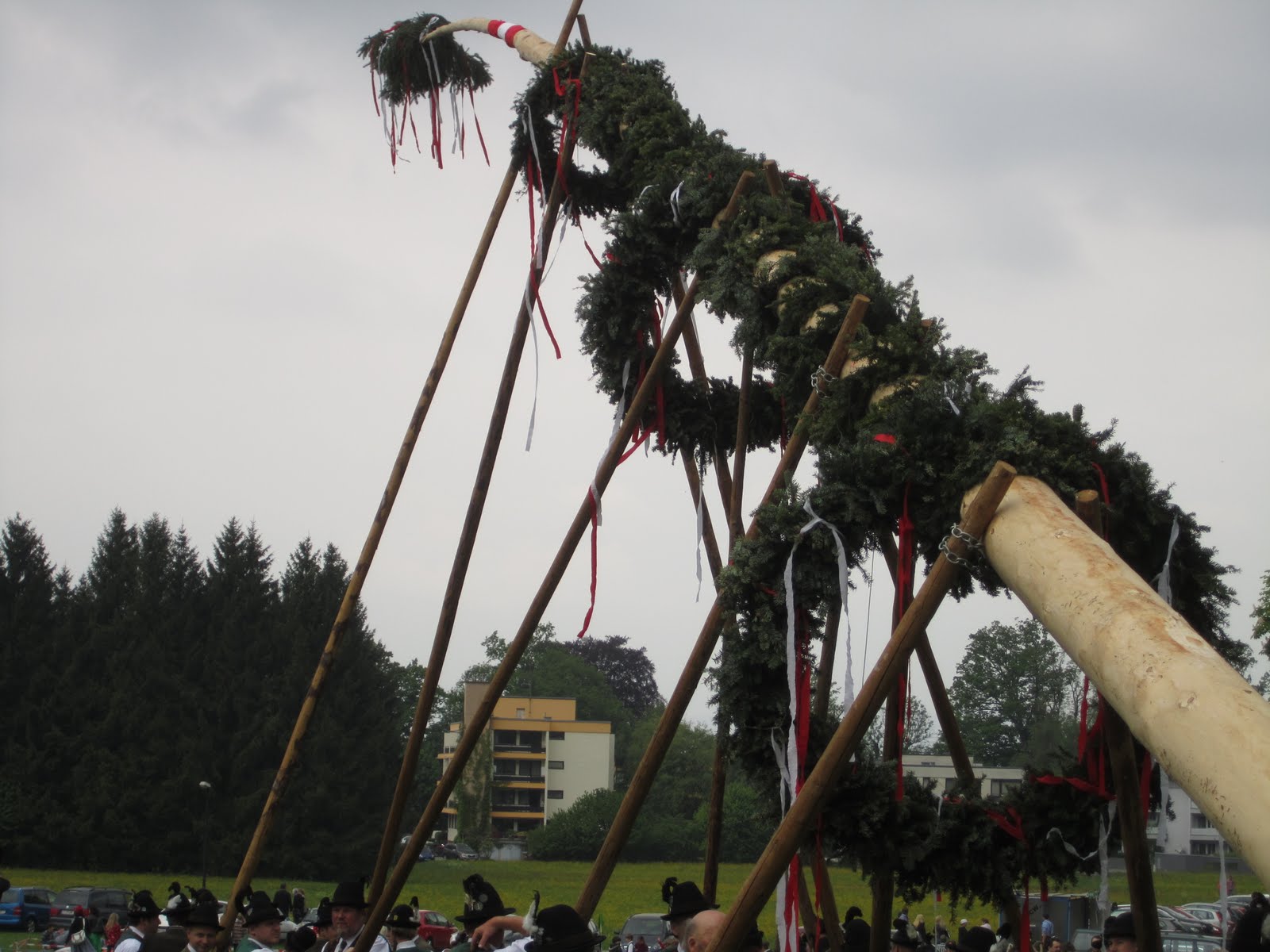
The tree, about two feet in diameter at its base, stretched over 100 feet long. Stripped of its bark, it shone a pale cream colour to its top, with was still covered with branches and green, like a diminutive Christmas tree at the tip of a long, tapering spike. Around the bare trunk were wound spirals of green decorated with streaming red and white ribbons. Circling the trunk, like twin rings of Saturn, were two wreaths of green suspended by wires. Midway between the highest of the wreaths and the tiny green top, broad stripes of red and white wrapped around the pole.
The tractor pulled the base of the tree toward a deep narrow trench at the top of the field, and slowly, very slowly, the men began inching the supports under the thick trunk backwards, so the base could be tilted into the trench. By now, I had begun to see that my anxiety not to miss anything had been unnecessary. Little did I know at the time it would take the 40 or so men over three hours to raise the tree fully upright.

Once the tractor was removed, they worked without any motorised lifts or support. Through a carefully choreographed process of supporting the trunk with large beams, they gradually shifted the gun carriage backward. As the treetop rose, inch by careful inch, they supported it with beams linked by heavy-gage chains that formed a kind of cradle in which it rested. They were directed in this by a kind of drum major, a man with a baton formed of a stick from which fluttered red and white streamers. Around the men holding the beams swarmed other men, some with long poles topped with a twin-spiked fork they jammed into the tree to reposition the chains, to add additional support and to mark the place that chains should go. Every so often the drum major would bark a command, the men would shove their weight into the beams, they would strain for a few seconds, the tree would rise, almost imperceptibly, and then they would rest.
Tied to their task, they stood in knots at various points along the ever rising tree, smoking and laughing at times. Occasionally others would bring them beers, ham-sized fists clutching the handles four or five heavy mugs in each hand. Desserts were brought out, too, which were eaten in some cases one handed, as the supports were held in place.

Around them swirled the crowd, eating, talking, drinking beer or soda or coffee, the children in their trachten standing at the edge waiting. About two hours into the process, the rain began, and the shoulders of the men’s leather jackets darkened with wet. Umbrellas bloomed in all colours over the watching crowd. Still the raising continued.

At last, though, sometime past 4 p.m., the tree stood erect and the twin wreaths of green swung around the posts levelly. Smaller logs were brought and a big, red-faced man grunted as he hammered them into the trench, firmly securing the tree. A chain saw was brought out to cut the logs even with the ground; I held my breath at each stroke, envisioning a slash across the trunk so laboriously put upright.

Now the fun for which the children had waited begun. A thick orange mat, like a donut, was put into position around the base of the trunk and children danced on it as the clamoured around the tree. A girl of about 10 put her arms around the base as others lifted her feet, trying to hoist her up.

Then a young man of about 20 stepped forward. Standing bareheaded in the light rain, he was stripped of his shirt, shoes and stockings. He had wet the front of his lederhosen, apparently to give them added traction against the smooth surface of the tree. But the rain had done its damage; the tree was too slippery and he could get no purchase.

One after another they tried. No one got more than a few feet up. One man, who approached it from the far side of where I stood, clung to it, arms and legs wrapped tight like bracelets, about 10 feet off the ground. Then he let go and dropped to the mat.

Austria it seems, is home to robust ambitions. The object here is not to dance around a pole with coloured streamers. No, here the goal is to erect a sturdy, tall tree and then climb it. And, perhaps, someone managed to reach as high as the dangling rings later in the evening. As for us, we collected our bikes and, sodden through and through, cycled back along the river and home.

Monday, April 4, 2011

Seed

It has been exactly a year since we moved into the flat by the wood. Last year, summer was upon us before we’d settled in, so we hadn’t a chance, it seemed, to indulge in the neighbourhood’s rituals of spring. It was all we could do to tame the lawn, left unmowed too long, never mind beginning a garden or putting out window boxes.

This year, though, we have time to take it in spring in this Salzburg neighbourhood: The faint green veil cast over the budding trees, the white clouds of blossom cloaking the magnolias and, especially, the bursts of brilliant yellow forsythia against the greening fields.

Here at the flat, we’re preparing for summer. We’ve been turning the plot in the corner of the garden. Last weekend I put seeds in containers – for coriander (cilantro), basil and leeks – and set them in front of a window in the sun. And Saturday, we picked up small containers of geraniums for the window boxes.

Strictly speaking, I suppose, these are not window boxes. Jacob, the craftsman who built this house, and whose ghost, I say, still haunts us, was not one to do things the pedestrian way. The window boxes that go with this flat don’t sit in front of windows, for a start. They slip into the curved ovoid openings in the otherwise solid balustrade that surrounds our first-story veranda.

Nor are they, strictly speaking, boxes. Rather, Jacob replicated the convex-concave silhouette of the openings (like a double-ended ogee turned on its side) in custom-made copper containers, four of them, that slide into the slots. Last summer, we left the slots empty; the oddly shaped copper containers sat in a heap on the patio below. This year the spirit moved me – was it Jacob’s petulant silence? – to fill them.

As usual, Jacob knew what he was about: The boxes, with their green leaves filtering the light through the gaps in the balustrade, soften the starkness of the veranda wall. Soon, I hope, scarlet and coral geraniums, accented by electric blue lobelia, will tumble down its pale stucco-and-stone surface.

The flower boxes in place, I swept up the litter on the veranda and scrubbed the stone tiles, clearing the evidence of using the veranda and balustrade as a bird feeding table all winter. All that remained of the bird feed were a few green nets with the last of the seed-and-suet balls, now reduced to tumble-sized lumps. I rearranged them as they hung from the bars that cross in front of the flower box slots. They would be gone soon, I reasoned, as yellow-and-blue tits, with their white-and-black striped heads, flitted boldly to the boxes and away. I will miss them, I realised. In the solitary days in front of this computer, I have grown used to watching the tits and blackbirds, robins and nuthatches, even the odd woodpeaker, come and go.

I wondered, too, about the bold black squirrel that has come regularly to the food. As the weather warmed and the supply of seed dwindled, I realised he, like the birds, would have to resume foraging on his own. I wondered out loud about this.

‘Are you nuts?’ asked Himself. ‘There’s a whole wood right there!’

He’s right, of course. The squirrel, with its quivering intelligence and quick boldness, can get along without us.

Still, this morning, it was with amusement mingled with sadness I watched the fat brown-black squirrel move along the top of the balustrade, stopping now and again to peer over the edge. He looked left, he looked right. No seed nets – the birds finished them off yesterday afternoon. He stared upward at the post from which one had been suspended last week. Nothing.

He put his nose to the stone, as if he could inhale any crumb of seed or bread that might be left. His long black ears twitched as he scoured the floor. What could possibly be left, I wondered, after my sweeping and scrubbing Saturday?

‘Poor little chap,’ said Himself, who was shaving, when I told him.

‘I hope you mean that,’ said I.

Wednesday, March 30, 2011

Blank

Lent began mildly this year. The weather was mild and dry, but a pall like pewter hung over Katzenstraße. The wind, though not cold, had the bite of the Santa Ana winds of Southern California. The still-bare towering trucks in the wood bent under its breath; birdsong was temporarily muted under its roar.

Away in the distance, the multi-layered crags and peaks of Untersberg seemed crisper that Wednesday morning three weeks ago, lavender-blue and white with snow stark against the silver-white of the clouds behind it. Here and there the grey and white clouds parted, revealing weak soft blue. But between the heights of Untersberg and this flat by the still-brown wood, stretched kilometre after kilometre of what that morning seemed void.

Ever since Silvester, through the merry weeks of Fasching, Himself and I mentally prepared ourselves for Lent. Most years – the exception was last year, when our move from Ireland fell in the middle of the season – we have together made a specific Lenten sacrifice. This year we again picked up the tradition and are forgoing our ritual glasses of wine with dinner, our glasses of whiskey and beer afterward. It is an alcohol-free season for us.

During the three weeks since Ash Wednesday, we have borne with equanimity the blankness implicit in that morning. Outside of Lent, when I encounter the hard spots in the afternoon, those take-a-deep-breath-and-soldier-on grey drudgery moments, there is usually the promise of the glass of wine with dinner or the anticipation of evening’s light reflected through a golden glass of malt. Now, in the absence of that promise, I take a deep breath and think, ‘It is good for you to feel the blankness. It is good to let it go, if only for a while.’

It may be good, but it is hard. I feel it is not so much the absence of alcohol that causes the struggle but the absence, these days, of a sense of self. Perhaps it is the absence of the drive within myself to do something or complete something important. I am reminded that the blankness of being can be felt amid the beauty of Salzburg as it can be felt in urban sprawl or desert or anywhere.

‘Wherever you go,’ runs the enigmatic expression, ‘there you are.’ And there are times when one must bear the burden, unsoftened, of feeling what it is to be ‘there’.

The experience of this Lenten discipline changes every time we practice it. I find it works best for me when I willingly embrace it. There have been years when I’ve felt coerced. There have been years when just the everyday pain of life was penance enough. This year, I am conscious of feeling the difference of time, the contraction and expansion of the hours after dinner. As the weeks pass, I begin to feel differently this passage of time.

When I feel most restless and irritable with the exercise, I call to mind these words, from Mindfulness in Plain English by Bhante Henepola Gunaratana:

‘"Discipline" is a difficult word for most of us. It conjures up images of somebody standing over you with a stick, telling you that you're wrong. But self-discipline is different. It's the skill of seeing through the hollow shouting of your own impulses and piercing their secret. They have no power over you. It's all a show, a deception. Your urges scream and bluster at you; they cajole; they coax; they threaten; but they really carry no stick at all. You give in out of habit. You give in because you never really bother to look beyond the threat. It is all empty back there. There is only one way to learn this lesson, though. The words on this page won't do it. But look within and watch the stuff coming up – restlessness, anxiety, impatience, pain – just watch it come up and don't get involved. Much to your surprise, it will simply go away. It rises, it passes away. As simple as that. There is another word for self-discipline. It is patience."’


Now, Spring comes forth boldly. The birds chatter all day long, the days dawn bright and warm, the floor of the wood next to the house is carpeted with green, and the daffodils swell with yellow. Through the explosion of life, I am hanging in there. I try to allow myself to bear the blankness and know that the swelling yellow buds and green haze of the trees mirror something within myself. I am trying to give myself the gift of patience. 

Thursday, March 17, 2011

Green, The Wearing of

Two years ago on this date, on a bright spring day, I stood in Cahir Square, Co Tipperary, and watched as representatives from the town’s clubs, schools, sports teams and merchants paraded past Cahir Castle, across the bridge over the Suir, up Castle street and around the square. Among the marchers were Hannah Rose, twins Ava and Michaela, and their big brother Callum, who are grandnieces and a grandnephew of Himself and me. Green, gold and white banners fluttered in the sun. The Cahir River Rescue team, of which Callum’s, Ava’s and Michaela’s father is a member, towed one of their boats in the procession.

After the parade ended, people milled in the streets. Children ate sweets and ices; parents shouted after them as they romped away. In the sun’s warmth, we visited with friends and family and watched as a bandstand was set up. Soon the music began, and local children and musicians sang and played their instruments. Then, as the music ended and the crowd broke up, I began walking down the town and out the road toward the Cahir Golf Club, on my way home. By pre-arrangement, Himself – who had gone ahead on an errand – met me on the road, and together we drove home.

Back in Garryroan – the townland just outside Cahir where our house stands – Peggy, my mother-in-law, had prepared a special meal of lamb and a nice bit of bacon (ham, for all the difference in it), mashed potatoes and cabbage. For Peggy, St Patrick’s day never lost its significance of as a Holy Day. The day began with mass, and the midday dinner would be as important as Sunday dinner. We shared a bottle of wine, and while Himself and I did the dishes – a formidable task always, after one of Peggy’s dinners – she went into the sitting room to rest. Later, Himself and I would meet with others in town for a drink. That evening, RTÉ would broadcast video of parades from all over the country, small towns and large, all with marching bands, children in school uniforms, sports teams in their colours, and, in the larger cities and towns, floats and costumed players, bands from America and beyond, festive amid banners and streamers and crowds.

St Patrick’s day in Ireland is both religious and patriotic holiday, a day off to celebrate both Saint and Country. People wear funny hats, to be sure, oversized bright green furry top hats, or hats representing foaming pints of Guinness. But, more importantly, their collars and labels sprout bunches of fresh shamrock, which is, along with the harp, the symbol of Ireland, the ‘wearing of the green.’

On this evening three years ago, Himself and I, along with his brother, walked through the rain and the muck of a terrible ‘durty’ evening across the fields outside Cashel, Co Tipperary. There a spectacular fireworks display and laser show was one of the national festive events to mark the day. The fireworks went ahead despite the rain. I stood on a hillside looking over the magnificent, historic Rock of Cashel and watched as rockets exploded against the murky sky. It was my first year living in Ireland and I felt a strange disconnect seeing a patriotic display comprising gold, green and white rather than red, white and blue. It was another in a string of adjustments, large and small, I hadn’t anticipated but which made sense in the moment.

This evening, I’m typing this in a room growing darker with the oncoming dusk. It has been grey and rainy all day, and I feel far from the festivities of Ireland or, for that matter, from the American exuberance surrounding the day. Soon, however, Himself will be home from the office. We’re both wearing our badges of shamrock encased in plastic, as we do every year on this day. We’ve planned to meet with some others from his office at an Italian restaurant for dinner. Then we’ll go up a narrow gasse under glowering Mönchsberg to Murphy’s Law, a pub run by a sometimes cantankerous Corkman. It will be crowded with Austrians, most likely, with a smattering of Americans and a handful of Irish, the noise and the crush growing as the evening goes on.

But now, in this quiet before we go out into the crowd, I pause for a moment to think of the hedgerows across from our house in Garryroan. Today they will still be brown and bronze after the harsh winter, but perhaps the bracken is just beginning to green. Perhaps there is the faintest haze of green as the beeches across the fields begin to bud.

And perhaps Peggy – if you were still there, Peggy – perhaps you would have brought in some willow, the catkins just swelling. We might even be able to find, were we there to look, the first of the pale primroses, half-hidden under the fall’s scatter of old leaves, the sight of which, Peggy, would bring a flush of child-like joy to your face. For me, that would make St Patrick’s day complete.

Beannachtaí Lá le Pádraig to all.

Wednesday, March 9, 2011

Fasching

Yesterday was Faschingsdienstag, the culmination of Fasching, as carnival is known in German-speaking Europe. It’s a season of silliness, costumes, music and noisemakers, and it’s unlike anything I’ve experienced in Ireland or in California.

Fasching began for us in January, when I happened, by pure luck, to be in the centre of Salzburg to witness the start of a Fasching band festival. Bands from all over Austria, Switzerland, Italy and Germany, dressed in outlandish costumes, played on platzes around the city for two days.

They played marching band instruments, with percussion sometimes augmented by traditional wooden blocks and clappers. Performing on outdoor stages, they played popular songs and traditional songs and marching songs, including one song that was repeated by all the bands through the day. A kind of anthem, I assume it’s associated with Fasching.

Himself and I were there again the next day when, with a huge crowd watching, the bands assembled and played along side one another. An MC egged us all on, and the crowded linked arms and swayed in time with the anthems. When it ended, band members mingled, laughing and talking, eating and drinking beer. Sometimes they stood in groups playing on and on. Dusk was gathering when we followed the last of the bands as it marched away.

Over the weeks since, I gathered what I could about Fasching from what was going on around me. Costumes and streamers of confetti were on sale in shops and grocery markets. Cases of sparkling wine were also prominently displayed. Several times on our way home from the city centre, we met people in costumes and painted faces waiting at bus stops. Last weekend we saw a brass band of about eight members playing on a bus as it pulled away. Just as the door closed, we heard the same Fasching anthem. I wanted to jump on the bus to hear them play it.

So yesterday, I bicycled into the Altstadt to see what I could of the last day of Fasching. It was a fine day warmed by a generous sun. Sandbars showed in the pale blue-green water of the Salzach, which is low right now. As I approached the city centre, there were dozens of people, many with bare legs and shoulders, lying on its steep grassy banks and playing on its sandy shore. A group of young people played a game that involved balancing bottles of beer in the sand then, at a signal, picking them up and drinking until someone shouted ‘Stop’.

I left my bike and simply walked, looking into shop windows and pausing now and again to read restaurant menus. I had heard that on Faschingsdienstag people wore costumes to work, so I was looking for as many costumes as I could find. Here and there were knots of children, sometimes shepherded by an adult, dressed up with painted faces. One group stood in narrow Linzergaße blowing noise makers nonstop. Another child of about five was dressed as a red devil. He looked up, wordless and unsmiling, at his father, who stood visiting with a friend.

Adults wore costumes too, the younger ones showing the most extravagant imaginations. Faces painted, dressed as pirates and oversized elves, as cowboys and sailors, in baby doll outfits and vamp clothes, they roamed the streets, arms over their companions’ shoulders, calling out to others and drinking beers. Sometimes there was no custom but bright coloured clothes, painted faces, wigs and outrageous hats. A waiter, dressed in the staid livery of the Hotel Sacher – the most expensive hotel in Salzburg – wore a bright orange fright wig as he served drinks on the hotel terrace.
When I had tired myself out walking, I turned to bike home again. Passing a bridge on my way, I stopped to see why a small crowd, some carrying placards, was milling about. A woman handed me a brochure and invited me to go to Rathausplatz. There was, she said, an exhibition celebrating the 100th anniversary of International Women’s Day.

Just then, a small band of women began playing jazzy-bluesy tunes while a news cameraman filmed them. One of the band, a big blonde woman in a bright violet jacket and matching violet glasses, played a terrific soprano sax. A young man in the crowd watching swayed and clapped as he watched.

I passed on the exhibition. The music and colour, laughter and sun, the women’s smiles as they played, had been enough for me.

Friday, March 4, 2011

Bus Discipline

When we moved to Salzburg  a year ago, I was warned that Austrians occasionally scold strangers in public. They have, I was told, great respect for order and discipline, and it would not be unusual for a old woman, for instance, to upbraid someone for riding a bike on the wrong side of the road or crossing the street against the light.

As it turned out, I’ve found Austrians to be more relaxed and accepting than those warnings suggested. There is a certain reserve, certainly, but there’s also much warmth, willingness to help and a great sense of fun.

We’ve also seen disorder we didn’t expect. Firecrackers and rockets have been exploding in the night from fields around us since well before Christmas. With Fasching – Carnival – reaching its climax, I expect it will continue for a few more days.

Silvester – New Year’s Eve – in the centre of Salzburg was nearly riotous. Every third person, it seemed, had an arsenal of large rockets. They exploded around us, bursting overhead without stop. When the official fireworks started, they were dulled by a pall of smoke and hard to distinguish from the private rockets still filling the sky.

And it’s every man for himself when it comes to queues in supermarkets or other public places. We’ve learned to push our way through and be vigilant about holding our place in line, because it’s likely that someone will try to jump ahead, given the chance.

But generally there is a great deal of decorum about public life. I notice it particularly on the buses, where riders are quiet and polite. Even when the buses are full of passengers, they are not noisy. Teenagers and school kids, boarding in bunches, joke and laugh, teasing each other. But they don’t shriek or shove. Loud conversations – whether face to face or on mobiles – are unusual. You see no litter, no graffiti or vandalism. There is no undercurrent of threat or intimidation. All seems orderly and safe.

Last week I boarded a bus right as the bells ringing at noon. Around me were knots of school children on their way home for lunch. Two boys about eight years old were sitting in the front seats. Sitting about six or seven row behind them, I saw that one of them was slapping other's head, playfully, I thought. Not paying too much attention, I was conscious only of a repeated motion, dark gloved hand against dark soft cap, a slight distraction as I looked out the window. 

A small man of about 75 wearing a traditional stiff felt hat was sitting two rows behind the kids. Suddenly he stood, reached over the head of the woman in front of him and walloped the kid doing the slapping. After striking the kid on the back of the head, he said something sharp and brief. Then he sat down and looked at the woman in the seat facing him, saying something with a smile and a quick little nod.

A little farther along the street, the two boys stood up and, with subdued faces, moved to the back of the bus. Obviously, they didn't know the man, nor do I think the man knew the woman.

I think I had just witnessed my first instance of a stranger doing his part to protect the public order.