This is not to say I'm abandoning The Spy. These pages represent my personal commitment to myself. However, because of my silence here, this is what I've been up to on the NileGuide site.
Saturday, May 21, 2011
The Spy at Another Site
Three months ago, I was asked to contribute to NileGuide, an travel planning site with on-the-ground 'Local Experts' in cities around the world. One of the reasons the Spy has been quiet is that writing for NileGuide has absorbed more time than I realised it would.


Another American Voice in Austria
I love this enthusiasm, verve and wit of this guy's look at Austrian life.He's in Vienna, and he loves living in Austria as much as I do. I wish I had his energy!
Saturday, May 14, 2011
Sixty
‘So. What do you want for your birthday?’
It is the annual question. And it was a question that this year, in particular, I didn’t want to consider.
Over the past few months, more than is usual, I’ve been struggling with the approach of my birthday. Turning sixty was forcing me, it seemed for the first time, to accept not just the reality of my mortality, but also the inevitability of those physical signs of aging – sagging skin, infirmity, the potential loss of mental acuity and memory, the window closing on experience.
I dread these things. I dread too the invisibility that comes with age. We creep closer to our ends looking backwards, seeing in our mental mirrors our youthful selves, feeling as if we were still twenty or twenty-five. But to the twenty-year-olds or the thirty-year-olds, even those in their forties, our sharp edges blur as our skin sags. We totter on the brink, all too often, of ridiculousness or, perhaps worse, child-like cuteness.
And why do I believe this? Haven’t I viewed those older than me in the same light?
Even the compassionate and sensitive young necessarily lack the experiential knowledge of how it feels to grow old. They can’t understand what it’s like to encounter that old person in the mirror when, inside, one feels no older than when one was twenty-five. And because they can’t appreciate that the old person’s daily experience is not, fundamentally, far removed from their own, it is we who are older who must do the heavy lifting of retaining relevance.
Only to a limited extent is there truth in what people keep urging me to remember, that age is just a number, that it’s all in our heads. Yes, in my head, I do feel twenty-five-years-old, but a wiser, more thoughtful, and less reactive twenty-five-year-old than the Lorraine of thirty-five years ago. It’s like being the twenty-five-year-old I wish I had been, back in the days when my face and body had the beauty, strength and stamina of a twenty-five-year-old. The reality is that the skin on the backs of my hands is thinning, that the ache in the bad shoulder burns every morning when I awake, and there may soon come a point when, much as I want to dance all night at a wedding, my moves will make me look ridiculous.
It’s the tragedy we all face, one way or another.
This is just part of the darkness I’ve kept at bay only with difficulty these past few months. I’ve grieved, too, lost opportunity and the failure to leave my mark. Even as I’ve worked to remain grounded in the experience of living in Salzburg, dread of aging and fear of my time running out have shadowed each day. I’ve had to remind myself daily to treasure my time here and all that it brings.
At the same time, daily life remains just that: quotidian. There are dishes to be washed and coffee grounds to be scooped out. The grocery marketing must be done and meals planned. Staying on top of the mess in the living room and office is no more romantic in Austria than it is in California. Simple tasks, such as making a doctor’s appointment, intimidate me still. And so the struggle to see my good fortune and hold onto joy in living requires more effort some days than others.
So Tuesday – my birthday – dawned. I woke up and went to my desk early, just as the gold crested the mountains behind me and gilded the trees that tower at the side of our house. I was sixty, and in the first fire of concentrated morning light, the trees glowed bright yellow-green, just as they did last week and just as I hope they will next year.
And how did I answer the question Himself had posed?
Laser treatment to remove the age spots? He was having none of that. A jar of the La Prairie cream my seventy-year-old friend with terrific skin swears by? I didn’t even ask.
In the end, only at the last minute, I asked for a Kindle. Though the romantic in me quailed at the thought of relinquishing the pleasures of well-thumbed pages and the richness of ink on paper, other desires won out. The selection of English-language books is limited here. Most titles, whether new or classic, must be ordered, a prospect that, when the mood is on me, fills me with impatience. The Kindle makes instant gratification possible, at least when it comes to books. And it turns out its design offers its own physical pleasures.
As for the rest of the day, its gold equalled the beauty of the gilded morning trees. We bicycled to the Altstadt and lunched on Mönchsberg’s height while looking over the blue-green Salzach and the domes and spires of the city. Then we took in the Giacometti exhibition at the Museum der Moderne. There were hugs from our Katzenstraße friends Sigrid and Edith as well as roses and wine. The warmth of tributes from Facebook friends overwhelmed me.
That evening, we had dinner in a picturesque Nonntal neighbourhood filled with graceful Baroque facades. Under a deepening blue sky, surrounded by warm scented air, we sat in the pretty garden of a Mexican restaurant. The illuminated Festung, perched at the edge of Mönchsberg’s bulk, watched us from overhead. In the peaceful evening, I enjoyed my annual margarita, continuing the birthday tradition I began thirty-five years ago.
And the twenty-five-year-old within enjoyed it every bit as much as I did.
Wednesday, May 11, 2011
Die Wäschespinner
After several days of rain, grey clouds and chill, it’s a bright, sunny day with just a few full white clouds. The trees in the wood next to the house are now fully in leaf; they tower against the sky, fresh green dramatic against the deep blue. From this first floor flat, even as I crane my head back, they rise so high I can’t see their tops. From within their hidden depths, birds celebrate the beautiful spring day.
During a phone call just now, my sister-in-law in Ireland and I compared notes on the weather. ‘It’s the first good day all week. Up and down the street,’ I said, everyone’s got wash on the line.’
‘I know,’ said she. ‘On mornings like that, I look around and say, “Now what can I wash?”’
‘Exactly! I do the same. Today I have the sheets and the bath towels hanging.’
And I do. The line is full of flapping yellow towels and white sheets, pale sails of a ship in a vast emerald sea. Standing at the window and looking down on them in the lawn below, I am filled with a calm joy. The sheets fill and billow, the four-sided wäschespinner whirls, and diamond-shaped shadows dapple the grass.
The clothesline is new, put it up a few weeks ago. Himself dug the hole, mixing and pouring the concrete, then carefully carving our initials and the date into pale-grey mass. I stood by, impatient to use the new line.
The fact is, this is my first clothesline. I can barely remember the clothes hanging outside the kitchen window of my childhood home. I must have been nine or ten when my mother got the automatic tumble-dryer, and after that, I don’t remember her using the clothesline. From then until we moved to Ireland three years ago, the main part of my laundry went into the dryer. Delicates and things that might shrink, of course, were dried on hangers, but that didn’t require a clothesline.
It’s indicative of the casual use – waste – of fuels that is a part of life in America. A neighbour told me when we first moved to Thousand Oaks, California, that there was a city law against clotheslines. I don’t know if she had her facts straight, and I never investigated. What would they do, anyway, give you a ticket if your laundry offended your neighbour? However, in 17 years living there, I never saw a clothesline full of wash. Whether there was a law or not, hanging laundry on a line just wasn’t done.
It’s ironic, really. In Southern California, we suffered through hot dry summers stretching through October, basked in the sun on Christmas Day, had barbecues on New Year’s Day, and restricted our watering because of years-long droughts. In Ireland, where rain may arrive at any moment, any time of the year, many only reluctently use their tumble dryers. If laundry hung on the line is caught in a rain shower, it is shrugged off as a ‘second rinse.’
In Ireland, though, we never got around to putting up a clothesline. I couldn’t decide where to put it – oh monumental decision! – and my mother-in-law, living next door, graciously allowed me to use hers. It was only about 50 metres from our back door, and we were back and forth between the two houses frequently anyway.
So when we moved to this flat a year ago, it was the first time in my life I had access to neither clothesline nor dryer. For the past year, I’ve been hanging my wash on a tublular stainless steel clothes horse, setting it up in the garden on good days or in the utility room where the boiler roars on bad ones. About a metre high and extending about a metre and a half wide, it did the job adequately. But never, until now, could I wash several loads on a single day. Never, until now, could I wash and hang the large bath towels and the sheets all on the same morning.

This evening when I take down the laundry, the socks and towels will be a little stiff, without the fluffiness that comes from a tumble dryer. The sheets and tea towels, too, will show some creasing, turned in at the corners and imprinted with the impression of the clothes pegs. They will be also stiff and slightly awkward to fold. But they will smell as sweet and fresh as the green of the leaves against the blue sky, and bring with them the sun of this May day. Mundane as this is, it is for me a source of quiet joy.
Tuesday, May 3, 2011
Raising the Tree
Labour Day is a national holiday in Austria. However, unlike in Vienna and other European cities, where May Day is very much a celebration of the Labour movement, Salzburg largely still holds to the tradition of Maibaumaufstellen. Translated frequently as May pole festival, this means, literally, ‘May tree set up’.
We were still settling in last year on May Day, so we missed the festivals. For weeks afterward, as we toured the neighbouring area, we’d occasionally pass the tall bare poles, with greenery still wrapped round its height, red and white ribbons still fluttering. But how it worked or what the festivals entailed was vague to me. I still had images, I suppose, of dancing flower-decked maidens weaving satin streamers round the pole.
So Sunday morning, when I located a May pole celebration online, Himself and I left promptly. I didn’t want to miss the main event, which I understood started at 1 p.m. Sure, I knew, there would be beer and wurstl, and people milling around in bright coloured trachten, all afternoon; that’s to be expected. But I wanted to see what the May pole celebration itself entailed.
We cycled along the river and, south of Kapuzinerberg, turned east, toward the sloping foothills to the pretty village of Aigen, where a picturesque church – remodelled in the Baroque style in 1698 – rises over a broad green field. A few cars were parked along the edge of the green, and stalls selling beer, grilled meats and sausages, cakes and pastries, and coffee and tea had been set up. A brass band was settling in too. And away, at a corner of the field, hitched to small blue tractor, an enormous tree lay on its side, supported midway along by a gun carriage. A couple of dozen men, members of der Historischen Prangerstutzenschützen, the club sponsoring the Maibaumaufstellen, milled around it. They wore their club uniform of traditional velvet vests, leather jacket and felt hats. And, just as we rolled our bikes to a halt, a volley of shots from huge blunderbusses erupted. The celebrations were just barely beginning.
It was a cloudy day; rain was predicted, and it hung heavily in the grey clouds. It was a day when Ireland seemed no farther than the next field, beyond the thick line of mature trees so intensely green they coloured the very air. But looking up the field, past the row of stalls, the church with its onion-domed steeple could not be mistaken. Nor could the people, the women in dirndls and men in lederhosen, worn with the casually, with the insouciance with which jeans are worn in Southern California – or anywhere in America or in Ireland, for that matter. (In Ireland, I suppose, you would substitute track suits for jeans.)
We debated getting something to eat then, as 1 p.m. approached, or waiting until after the action was over. We were hungry, so we got some grilled chops with vinegary potato salad and slaw and chose seats at one of the many, mostly empty, tables. Near us, a group of young men in the careless assortment of lederhosen and heavy shoes and socks paired with tee-shirts and casual jackets, laughed and joked over beer and cigarettes. No one paid any attention to the group gathered around the tractor and tree.
But soon the tractor started rolling slowly toward the open centre of the field. Behind it, the members of der Historischen Prangerstutzenschützen formed an honour guard along side the tree. I jumped up with my camera, anxious to see all there was to see. Still, no one else stirred.
The tree, about two feet in diameter at its base, stretched over 100 feet long. Stripped of its bark, it shone a pale cream colour to its top, with was still covered with branches and green, like a diminutive Christmas tree at the tip of a long, tapering spike. Around the bare trunk were wound spirals of green decorated with streaming red and white ribbons. Circling the trunk, like twin rings of Saturn, were two wreaths of green suspended by wires. Midway between the highest of the wreaths and the tiny green top, broad stripes of red and white wrapped around the pole.

The tractor pulled the base of the tree toward a deep narrow trench at the top of the field, and slowly, very slowly, the men began inching the supports under the thick trunk backwards, so the base could be tilted into the trench. By now, I had begun to see that my anxiety not to miss anything had been unnecessary. Little did I know at the time it would take the 40 or so men over three hours to raise the tree fully upright.
Once the tractor was removed, they worked without any motorised lifts or support. Through a carefully choreographed process of supporting the trunk with large beams, they gradually shifted the gun carriage backward. As the treetop rose, inch by careful inch, they supported it with beams linked by heavy-gage chains that formed a kind of cradle in which it rested. They were directed in this by a kind of drum major, a man with a baton formed of a stick from which fluttered red and white streamers. Around the men holding the beams swarmed other men, some with long poles topped with a twin-spiked fork they jammed into the tree to reposition the chains, to add additional support and to mark the place that chains should go. Every so often the drum major would bark a command, the men would shove their weight into the beams, they would strain for a few seconds, the tree would rise, almost imperceptibly, and then they would rest.
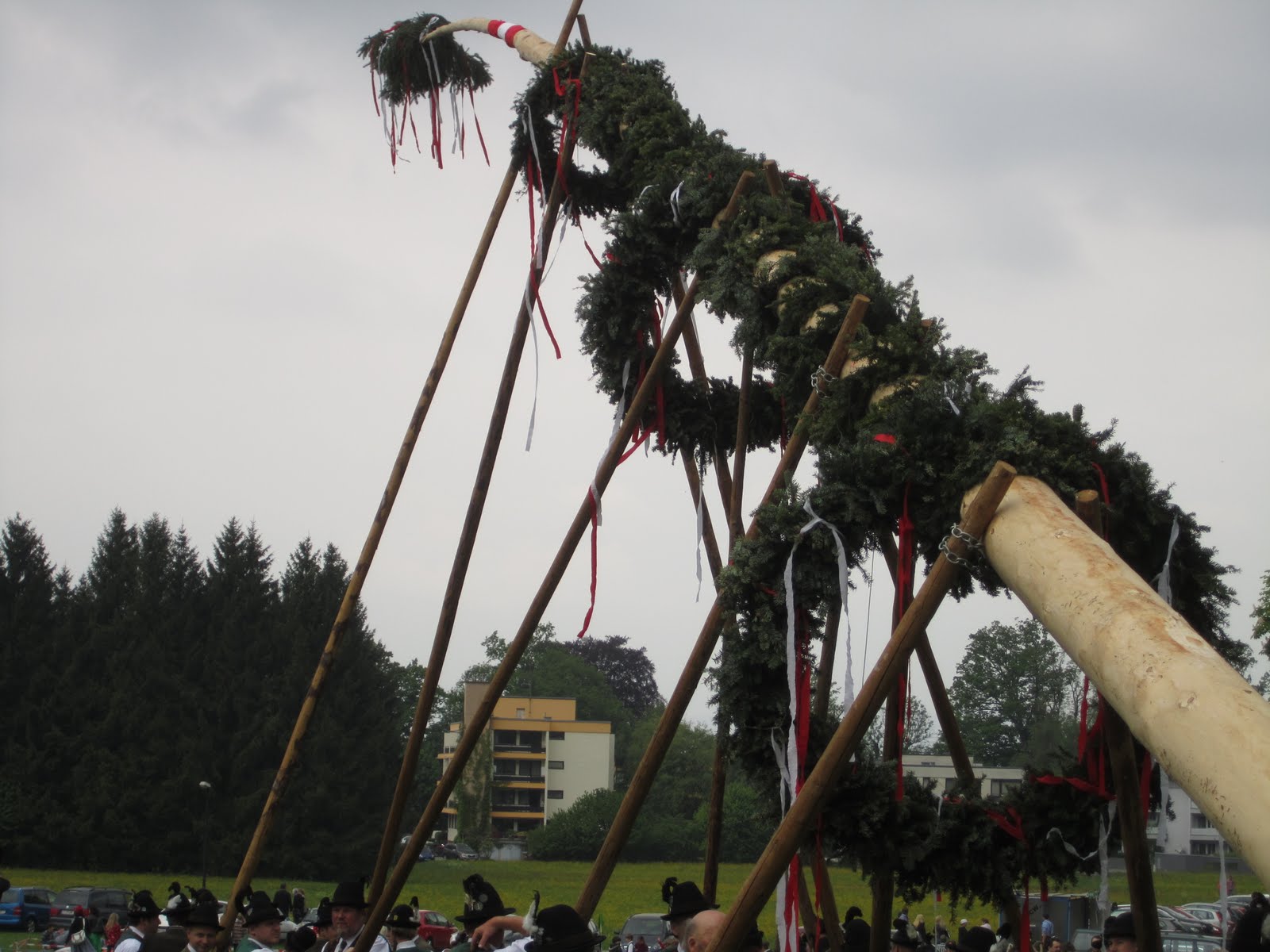
Tied to their task, they stood in knots at various points along the ever rising tree, smoking and laughing at times. Occasionally others would bring them beers, ham-sized fists clutching the handles four or five heavy mugs in each hand. Desserts were brought out, too, which were eaten in some cases one handed, as the supports were held in place.
Around them swirled the crowd, eating, talking, drinking beer or soda or coffee, the children in their trachten standing at the edge waiting. About two hours into the process, the rain began, and the shoulders of the men’s leather jackets darkened with wet. Umbrellas bloomed in all colours over the watching crowd. Still the raising continued.
At last, though, sometime past 4 p.m., the tree stood erect and the twin wreaths of green swung around the posts levelly. Smaller logs were brought and a big, red-faced man grunted as he hammered them into the trench, firmly securing the tree. A chain saw was brought out to cut the logs even with the ground; I held my breath at each stroke, envisioning a slash across the trunk so laboriously put upright.
Now the fun for which the children had waited begun. A thick orange mat, like a donut, was put into position around the base of the trunk and children danced on it as the clamoured around the tree. A girl of about 10 put her arms around the base as others lifted her feet, trying to hoist her up.
Then a young man of about 20 stepped forward. Standing bareheaded in the light rain, he was stripped of his shirt, shoes and stockings. He had wet the front of his lederhosen, apparently to give them added traction against the smooth surface of the tree. But the rain had done its damage; the tree was too slippery and he could get no purchase.

One after another they tried. No one got more than a few feet up. One man, who approached it from the far side of where I stood, clung to it, arms and legs wrapped tight like bracelets, about 10 feet off the ground. Then he let go and dropped to the mat.
Austria it seems, is home to robust ambitions. The object here is not to dance around a pole with coloured streamers. No, here the goal is to erect a sturdy, tall tree and then climb it. And, perhaps, someone managed to reach as high as the dangling rings later in the evening. As for us, we collected our bikes and, sodden through and through, cycled back along the river and home.
Monday, April 4, 2011
Seed
It has been exactly a year since we moved into the flat by the wood. Last year, summer was upon us before we’d settled in, so we hadn’t a chance, it seemed, to indulge in the neighbourhood’s rituals of spring. It was all we could do to tame the lawn, left unmowed too long, never mind beginning a garden or putting out window boxes.
This year, though, we have time to take it in spring in this Salzburg neighbourhood: The faint green veil cast over the budding trees, the white clouds of blossom cloaking the magnolias and, especially, the bursts of brilliant yellow forsythia against the greening fields.
Here at the flat, we’re preparing for summer. We’ve been turning the plot in the corner of the garden. Last weekend I put seeds in containers – for coriander (cilantro), basil and leeks – and set them in front of a window in the sun. And Saturday, we picked up small containers of geraniums for the window boxes.
Strictly speaking, I suppose, these are not window boxes. Jacob, the craftsman who built this house, and whose ghost, I say, still haunts us, was not one to do things the pedestrian way. The window boxes that go with this flat don’t sit in front of windows, for a start. They slip into the curved ovoid openings in the otherwise solid balustrade that surrounds our first-story veranda.
Nor are they, strictly speaking, boxes. Rather, Jacob replicated the convex-concave silhouette of the openings (like a double-ended ogee turned on its side) in custom-made copper containers, four of them, that slide into the slots. Last summer, we left the slots empty; the oddly shaped copper containers sat in a heap on the patio below. This year the spirit moved me – was it Jacob’s petulant silence? – to fill them.
As usual, Jacob knew what he was about: The boxes, with their green leaves filtering the light through the gaps in the balustrade, soften the starkness of the veranda wall. Soon, I hope, scarlet and coral geraniums, accented by electric blue lobelia, will tumble down its pale stucco-and-stone surface.
The flower boxes in place, I swept up the litter on the veranda and scrubbed the stone tiles, clearing the evidence of using the veranda and balustrade as a bird feeding table all winter. All that remained of the bird feed were a few green nets with the last of the seed-and-suet balls, now reduced to tumble-sized lumps. I rearranged them as they hung from the bars that cross in front of the flower box slots. They would be gone soon, I reasoned, as yellow-and-blue tits, with their white-and-black striped heads, flitted boldly to the boxes and away. I will miss them, I realised. In the solitary days in front of this computer, I have grown used to watching the tits and blackbirds, robins and nuthatches, even the odd woodpeaker, come and go.
I wondered, too, about the bold black squirrel that has come regularly to the food. As the weather warmed and the supply of seed dwindled, I realised he, like the birds, would have to resume foraging on his own. I wondered out loud about this.
‘Are you nuts?’ asked Himself. ‘There’s a whole wood right there!’
He’s right, of course. The squirrel, with its quivering intelligence and quick boldness, can get along without us.
Still, this morning, it was with amusement mingled with sadness I watched the fat brown-black squirrel move along the top of the balustrade, stopping now and again to peer over the edge. He looked left, he looked right. No seed nets – the birds finished them off yesterday afternoon. He stared upward at the post from which one had been suspended last week. Nothing.
He put his nose to the stone, as if he could inhale any crumb of seed or bread that might be left. His long black ears twitched as he scoured the floor. What could possibly be left, I wondered, after my sweeping and scrubbing Saturday?
‘Poor little chap,’ said Himself, who was shaving, when I told him.
‘I hope you mean that,’ said I.
Wednesday, March 30, 2011
Blank
Lent began mildly this year. The weather was mild and dry, but a pall like pewter hung over Katzenstraße. The wind, though not cold, had the bite of the Santa Ana winds of Southern California. The still-bare towering trucks in the wood bent under its breath; birdsong was temporarily muted under its roar.
Away in the distance, the multi-layered crags and peaks of Untersberg seemed crisper that Wednesday morning three weeks ago, lavender-blue and white with snow stark against the silver-white of the clouds behind it. Here and there the grey and white clouds parted, revealing weak soft blue. But between the heights of Untersberg and this flat by the still-brown wood, stretched kilometre after kilometre of what that morning seemed void.
Ever since Silvester, through the merry weeks of Fasching, Himself and I mentally prepared ourselves for Lent. Most years – the exception was last year, when our move from Ireland fell in the middle of the season – we have together made a specific Lenten sacrifice. This year we again picked up the tradition and are forgoing our ritual glasses of wine with dinner, our glasses of whiskey and beer afterward. It is an alcohol-free season for us.
During the three weeks since Ash Wednesday, we have borne with equanimity the blankness implicit in that morning. Outside of Lent, when I encounter the hard spots in the afternoon, those take-a-deep-breath-and-soldier-on grey drudgery moments, there is usually the promise of the glass of wine with dinner or the anticipation of evening’s light reflected through a golden glass of malt. Now, in the absence of that promise, I take a deep breath and think, ‘It is good for you to feel the blankness. It is good to let it go, if only for a while.’
It may be good, but it is hard. I feel it is not so much the absence of alcohol that causes the struggle but the absence, these days, of a sense of self. Perhaps it is the absence of the drive within myself to do something or complete something important. I am reminded that the blankness of being can be felt amid the beauty of Salzburg as it can be felt in urban sprawl or desert or anywhere.
‘Wherever you go,’ runs the enigmatic expression, ‘there you are.’ And there are times when one must bear the burden, unsoftened, of feeling what it is to be ‘there’.
The experience of this Lenten discipline changes every time we practice it. I find it works best for me when I willingly embrace it. There have been years when I’ve felt coerced. There have been years when just the everyday pain of life was penance enough. This year, I am conscious of feeling the difference of time, the contraction and expansion of the hours after dinner. As the weeks pass, I begin to feel differently this passage of time.
When I feel most restless and irritable with the exercise, I call to mind these words, from Mindfulness in Plain English by Bhante Henepola Gunaratana:
‘"Discipline" is a difficult word for most of us. It conjures up images of somebody standing over you with a stick, telling you that you're wrong. But self-discipline is different. It's the skill of seeing through the hollow shouting of your own impulses and piercing their secret. They have no power over you. It's all a show, a deception. Your urges scream and bluster at you; they cajole; they coax; they threaten; but they really carry no stick at all. You give in out of habit. You give in because you never really bother to look beyond the threat. It is all empty back there. There is only one way to learn this lesson, though. The words on this page won't do it. But look within and watch the stuff coming up – restlessness, anxiety, impatience, pain – just watch it come up and don't get involved. Much to your surprise, it will simply go away. It rises, it passes away. As simple as that. There is another word for self-discipline. It is patience."’
Now, Spring comes forth boldly. The birds chatter all day long, the days dawn bright and warm, the floor of the wood next to the house is carpeted with green, and the daffodils swell with yellow. Through the explosion of life, I am hanging in there. I try to allow myself to bear the blankness and know that the swelling yellow buds and green haze of the trees mirror something within myself. I am trying to give myself the gift of patience.
Subscribe to:
Posts (Atom)

