Wednesday, June 8, 2011

Summer Skies

While it would be gross fabrication to say I miss the U.S., it would be mere exaggeration to say I am homesick for Ireland. We followed the Queen’s recent visit with uncanny fascination, surprised at the waves of emotion that overcame us at the reconciliation and mutual respect that arose from the ceremonies. I regretted that I could not stand near the motorway running between Cashel and Cork to see her motorcade pass – until I realised they made the journey by helicopter. Still, in my mind’s eye, I stood at our sitting room window in Tipperary and saw – across the pastures of Tincurry – her Range Rover glide through the landscape, past the gaze of Galtymore.

Likewise, we would have liked to have been there to see the crowds welcoming Obama, though, as it happened, we were in Italy during his visit. As well, when Tipperary recently beat Cork, its long-standing nemesis, in the first test of the summer-long hurling national championship, we wished we could have been watching the match from the comfort of the Garryroan sitting room.

Those are public occasions, of course. The twinges of nostalgia, those passing moments of longing, more often come in the odd, private moment. Weeding the garden in the stillness of an overcast afternoon, the breeze soft and pregnant with rain, the clear trill of blackbirds the loudest sound I hear, I am put in mind the long, overgrown garden at the back of my mother-in-law’s house. Looking up, I notice the swell of currents and ripening raspberries on the bush, and I wish, once more, that she could have seen our garden here.

I recall also the low rolling hills of Ireland, green fields cross hatched by deeper green hedgerows and grey clouds swelling on the horizon. Perhaps the memory is triggered by a photo; perhaps it comes suddenly to my imagination. The Austrian landscape is beautiful, its wide open meadows spreading against the soaring Alps breathtaking. The ancient onion-domed steeples and charming villages, dignified in these vast spaces, still astonish me. But my response to the Irish landscape, whether imagined or seen, is instinctual, as if primordial. It’s the quickening recognition that draws one toward a long-missed loved one.

It’s not just the landscape I miss, of course. I think of languorous warm Sunday afternoons, when, dinner dishes done, we wander aimlessly. Waiting, perhaps, for the Sunday match to begin, we sit in the glassed-in porch of my mother-in-law’s house, where, overheated by the welcome sun, acrid dust rising from the elderly brown cushions competes with the sharp scent of geraniums. Or we drift to the long tunnel of the polythene house, where the interior temperature rises a good 10 degrees higher than the cool afternoon. Flying insects ping against its taut surface; the air is rank with humus and sweet with ripe peaches and apricots. Rusted tools, rough twine, unspooled in irregular loops, faded boxes and broken crockery litter the tottering timber table. A drumming flutter beats against the plastic in the corner as a thrush, frantic, finds her way out the opening at the far end.

Later, in the long evening, we sit outside, if we’re lucky, to watch the colour drain from the light over the tips of the towering hedges. We try to distinguish the music of the thrush from the melody of the blackbird. Overhead, swallows and swifts dance their soaring song, filling the sky with swooping arabesques, their high chattering cries hanging in the air. They fill me with contentment.

We see no swallows from our veranda in Salzburg. I spotted, last summer, a few over the Salzach as I cycled along it in the evening. They flitted over the river, dancing from current to current just above the water, their cries muffled by the roar of the water. But they do not dance over our garden.

So it was with exhilaration I listened to the high shrill twittering of a sky full of swallows above the basilica in Padua. They soared too over the campos and canals of Venice, filling the heaven with their shrieks, weaving an elegant ballet against the fading blue light, blue reflected and intensified by the mirror-like waters below. In the heat of an Italian evening, I saw the swallows and thought of Ireland and home.

View of the Galtee Mountains from Garryroan, South Tipperary, Ireland
Photo by Lorraine Seal

Monday, June 6, 2011

Giotto in Padua

In February, we made a trip to Rome in celebration of our 25th anniversary. To celebrate my  60th birthday, I requested a trip to Venice, a city I never imagined I’d have a chance to visit and of which I had few mental images.

Venice has the advantage of being within driving distance of Salzburg, something over five hours. Rather than make the whole journey in a day, we booked four nights in Venice, and then, working backwards, I booked a night in Sirmione, one of dozens of towns and villages that dot the shores of Lago di Garda, the large Alpine lake in the north of Italy, and another night in Padua, which lies less than a hour west of Venice. I had left one night open, the last night of the week and, at the urging of our sister-in-law, Moyra, we decided to spend it in Verona on our return journey.

Venice, Padua and Verona are cities associated in my mind with the plays of Shakespeare, with literature I haven’t necessarily read, and with the ghosts of art history lectures decades ago. It was then I fell in love with medieval and early Renaissance Western art with little expectation I would ever see the masterpieces in situ.

So it was with taut nerves and hard-to-contain excitement that I waited with about twenty others to be admitted to the Cappella degli Scrovegni in Padua to see the cycle of frescoes painted by Giotto for the ruling family of Padua in their private chapel. Depicting scenes from the life of Mary, mother of Jesus, from the life of Anne, her mother, and from the life of Christ, the cycle was completed in 1305. It is considered to be one of the masterpieces of Western art. 

An early master, Giotto bridges the divide between the stiffer, hierarchical figures painted against gold ground that mark medieval work and the opening up of perspective with naturalistic settings and more lifelike figures that heralded the coming of the Renaissance. Put plainly, he was one of the artists who opened our eyes so we could see the world differently.

The high, round vault of the chapel in Padua is painted deep blue with a regular pattern of gold stars. Across the ceiling and down the walls patterned bands of colour divide the space into panels, each of which frames a different scene from Mary’s life, so the whole is viewed like a picture book. They are lovely; the colours, both rich and soft, are varied. Giotto shows technical skill, too. The modelling of the drapery carefully rendered to indicate the solidity of the flesh, bone and muscle beneath. Backgrounds are simple but there is early use of perspective, so the depth of a scene in shown. Decorative borders under some of the panels are painted with such skill that they appear as if carved from wall.

But what draws one to the paintings is the humanness of the figures. Faces are beautiful and expressive. Tears stream down the mothers’ faces in the scene depicting the massacre of the innocents. The faces of Mary, her companions and John the Baptist are anguished as they cradle the body of the dead Christ, disposed from the cross. Over their heads, tiny angels mourn, arms spread in agony or clutched to their faces. In these faces, the artist captures vulnerability, volatility, softness and beauty.
Giotto, The Lamentation, Cappella degli Scrovegni, Padua.
Image courtesy of Wikimedia Commons.
Still, Giotto’s naturalism is not the realism of the later Renaissance and Baroque. The figures are charming and lifelike in the way of beautifully drawn picture book. They lack the full physicality and complete individualisation of painting that would follow in later centuries. However, like a child, I wanted to study every small detail, to hold them in my mind, to somehow own them though my first-hand experience of them. I love the translucence of the water that laps around Jesus’ legs as he stands in the Sea of Galilee while John baptises him. I love the delicately overlapping feathers in the angels’ wings and the softness of the women’s faces. Since I first was introduced to these works, in slides and four-colour pictures over thirty years ago, I have wanted to be in their presence.

Giotto, The Kiss of Judas, Cappella degli Scrovegni, Padua.
Image courtesy of Wikimedia Commons.
Frescoes are created by mixing pigment in plaster that is painted onto the surface of a wall, so they are chemically bound to it. This gives them durability, but they can be damaged by exposure to the elements, in particular salt. The frescos of Giotto in Padua are still in place more than seven hundred years – nearly three-quarters of a millennium – after they were created. Yet they have suffered some damage; to protect them from the effects of humidity caused by respiration, only twenty-five people at one time are admitted, and then for only fifteen minutes. All too soon for me, our fifteen minutes were up, and we were escorted out, passing on our way the next group of twenty-five waiting to be ushered in.

So Himself and I came out of the dim chapel into the heat and glare of a May afternoon in Padua. Before us stretched the week in Venice, where we would see many more landmark paintings and many more masterpieces of art. Seeing the Giotto frescoes was but one dream fulfilled. I can’t hold them in memory as acutely as I would like: to write this, I referred to images online, pale imitations of the originals that can only hint at their power.

I am lucky to have had the chance to worship at their shrine, inconceivably so. Little by little, I am learning to see the world differently.

Saturday, May 21, 2011

The Spy at Another Site

Three months ago, I was asked to contribute to NileGuide, an travel planning site with on-the-ground 'Local Experts' in cities around the world. One of the reasons the Spy has been quiet is that writing for NileGuide has absorbed more time than I realised it would.

This is not to say I'm abandoning The Spy. These pages represent my personal commitment to myself. However, because of my silence here, this is what I've been up to on the NileGuide site.

Another American Voice in Austria

I love this enthusiasm, verve and wit of this guy's look at Austrian life.He's in Vienna, and he loves living in Austria as much as I do. I wish I had his energy!

Saturday, May 14, 2011

Sixty

‘So. What do you want for your birthday?’

It is the annual question. And it was a question that this year, in particular, I didn’t want to consider.

Over the past few months, more than is usual, I’ve been struggling with the approach of my birthday. Turning sixty was forcing me, it seemed for the first time, to accept not just the reality of my mortality, but also the inevitability of those physical signs of aging – sagging skin, infirmity, the potential loss of mental acuity and memory, the window closing on experience.

I dread these things. I dread too the invisibility that comes with age. We creep closer to our ends looking backwards, seeing in our mental mirrors our youthful selves, feeling as if we were still twenty or twenty-five. But to the twenty-year-olds or the thirty-year-olds, even those in their forties, our sharp edges blur as our skin sags. We totter on the brink, all too often, of ridiculousness or, perhaps worse, child-like cuteness.

And why do I believe this? Haven’t I viewed those older than me in the same light?

Even the compassionate and sensitive young necessarily lack the experiential knowledge of how it feels to grow old. They can’t understand what it’s like to encounter that old person in the mirror when, inside, one feels no older than when one was twenty-five. And because they can’t appreciate that the old person’s daily experience is not, fundamentally, far removed from their own, it is we who are older who must do the heavy lifting of retaining relevance.

Only to a limited extent is there truth in what people keep urging me to remember, that age is just a number, that it’s all in our heads. Yes, in my head, I do feel twenty-five-years-old, but a wiser, more thoughtful, and less reactive twenty-five-year-old than the Lorraine of thirty-five years ago. It’s like being the twenty-five-year-old I wish I had been, back in the days when my face and body had the beauty, strength and stamina of a twenty-five-year-old. The reality is that the skin on the backs of my hands is thinning, that the ache in the bad shoulder burns every morning when I awake, and there may soon come a point when, much as I want to dance all night at a wedding, my moves will make me look ridiculous.

It’s the tragedy we all face, one way or another.

This is just part of the darkness I’ve kept at bay only with difficulty these past few months. I’ve grieved, too, lost opportunity and the failure to leave my mark. Even as I’ve worked to remain grounded in the experience of living in Salzburg, dread of aging and fear of my time running out have shadowed each day. I’ve had to remind myself daily to treasure my time here and all that it brings.

At the same time, daily life remains just that: quotidian. There are dishes to be washed and coffee grounds to be scooped out. The grocery marketing must be done and meals planned. Staying on top of the mess in the living room and office is no more romantic in Austria than it is in California. Simple tasks, such as making a doctor’s appointment, intimidate me still. And so the struggle to see my good fortune and hold onto joy in living requires more effort some days than others.

So Tuesday – my birthday – dawned. I woke up and went to my desk early, just as the gold crested the mountains behind me and gilded the trees that tower at the side of our house. I was sixty, and in the first fire of concentrated morning light, the trees glowed bright yellow-green, just as they did last week and just as I hope they will next year.

And how did I answer the question Himself had posed?

Laser treatment to remove the age spots? He was having none of that. A jar of the La Prairie cream my seventy-year-old friend with terrific skin swears by? I didn’t even ask.

In the end, only at the last minute, I asked for a Kindle. Though the romantic in me quailed at the thought of relinquishing the pleasures of well-thumbed pages and the richness of ink on paper, other desires won out. The selection of English-language books is limited here. Most titles, whether new or classic, must be ordered, a prospect that, when the mood is on me, fills me with impatience. The Kindle makes instant gratification possible, at least when it comes to books. And it turns out its design offers its own physical pleasures.

As for the rest of the day, its gold equalled the beauty of the gilded morning trees. We bicycled to the Altstadt and lunched on Mönchsberg’s height while looking over the blue-green Salzach and the domes and spires of the city. Then we took in the Giacometti exhibition at the Museum der Moderne. There were hugs from our Katzenstraße friends Sigrid and Edith as well as roses and wine. The warmth of tributes from Facebook friends overwhelmed me.

That evening, we had dinner in a picturesque Nonntal neighbourhood filled with graceful Baroque facades. Under a deepening blue sky, surrounded by warm scented air, we sat in the pretty garden of a Mexican restaurant. The illuminated Festung, perched at the edge of Mönchsberg’s bulk, watched us from overhead. In the peaceful evening, I enjoyed my annual margarita, continuing the birthday tradition I began thirty-five years ago.

And the twenty-five-year-old within enjoyed it every bit as much as I did.

Wednesday, May 11, 2011

Die Wäschespinner

After several days of rain, grey clouds and chill, it’s a bright, sunny day with just a few full white clouds. The trees in the wood next to the house are now fully in leaf; they tower against the sky, fresh green dramatic against the deep blue. From this first floor flat, even as I crane my head back, they rise so high I can’t see their tops. From within their hidden depths, birds celebrate the beautiful spring day.

During a phone call just now, my sister-in-law in Ireland and I compared notes on the weather. ‘It’s the first good day all week. Up and down the street,’ I said, everyone’s got wash on the line.’

‘I know,’ said she. ‘On mornings like that, I look around and say, “Now what can I wash?”’

‘Exactly! I do the same. Today I have the sheets and the bath towels hanging.’

And I do. The line is full of flapping yellow towels and white sheets, pale sails of a ship in a vast emerald sea. Standing at the window and looking down on them in the lawn below, I am filled with a calm joy. The sheets fill and billow, the four-sided wäschespinner whirls, and diamond-shaped shadows dapple the grass.

The clothesline is new, put it up a few weeks ago. Himself dug the hole, mixing and pouring the concrete, then carefully carving our initials and the date into pale-grey mass. I stood by, impatient to use the new line.

The fact is, this is my first clothesline. I can barely remember the clothes hanging outside the kitchen window of my childhood home. I must have been nine or ten when my mother got the automatic tumble-dryer, and after that, I don’t remember her using the clothesline. From then until we moved to Ireland three years ago, the main part of my laundry went into the dryer. Delicates and things that might shrink, of course, were dried on hangers, but that didn’t require a clothesline.

It’s indicative of the casual use – waste – of fuels that is a part of life in America. A neighbour told me when we first moved to Thousand Oaks, California, that there was a city law against clotheslines. I don’t know if she had her facts straight, and I never investigated. What would they do, anyway, give you a ticket if your laundry offended your neighbour? However, in 17 years living there, I never saw a clothesline full of wash. Whether there was a law or not, hanging laundry on a line just wasn’t done.

It’s ironic, really. In Southern California, we suffered through hot dry summers stretching through October, basked in the sun on Christmas Day, had barbecues on New Year’s Day, and restricted our watering because of years-long droughts. In Ireland, where rain may arrive at any moment, any time of the year, many only reluctently use their tumble dryers. If laundry hung on the line is caught in a rain shower, it is shrugged off as a ‘second rinse.’

In Ireland, though, we never got around to putting up a clothesline. I couldn’t decide where to put it – oh monumental decision! – and my mother-in-law, living next door, graciously allowed me to use hers. It was only about 50 metres from our back door, and we were back and forth between the two houses frequently anyway.

So when we moved to this flat a year ago, it was the first time in my life I had access to neither clothesline nor dryer. For the past year, I’ve been hanging my wash on a tublular stainless steel clothes horse, setting it up in the garden on good days or in the utility room where the boiler roars on bad ones. About a metre high and extending about a metre and a half wide, it did the job adequately. But never, until now, could I wash several loads on a single day. Never, until now, could I wash and hang the large bath towels and the sheets all on the same morning.

This evening when I take down the laundry, the socks and towels will be a little stiff, without the fluffiness that comes from a tumble dryer. The sheets and tea towels, too, will show some creasing, turned in at the corners and imprinted with the impression of the clothes pegs. They will be also stiff and slightly awkward to fold. But they will smell as sweet and fresh as the green of the leaves against the blue sky, and bring with them the sun of this May day. Mundane as this is, it is for me a source of quiet joy.

Tuesday, May 3, 2011

Raising the Tree

Labour Day is a national holiday in Austria. However, unlike in Vienna and other European cities, where May Day is very much a celebration of the Labour movement, Salzburg largely still holds to the tradition of Maibaumaufstellen. Translated frequently as May pole festival, this means, literally, ‘May tree set up’.

We were still settling in last year on May Day, so we missed the festivals. For weeks afterward, as we toured the neighbouring area, we’d occasionally pass the tall bare poles, with greenery still wrapped round its height, red and white ribbons still fluttering. But how it worked or what the festivals entailed was vague to me. I still had images, I suppose, of dancing flower-decked maidens weaving satin streamers round the pole.

So Sunday morning, when I located a May pole celebration online, Himself and I left promptly. I didn’t want to miss the main event, which I understood started at 1 p.m. Sure, I knew, there would be beer and wurstl, and people milling around in bright coloured trachten, all afternoon; that’s to be expected. But I wanted to see what the May pole celebration itself entailed.

We cycled along the river and, south of Kapuzinerberg, turned east, toward the sloping foothills to the pretty village of Aigen, where a picturesque church – remodelled in the Baroque style in 1698 – rises over a broad green field. A few cars were parked along the edge of the green, and stalls selling beer, grilled meats and sausages, cakes and pastries, and coffee and tea had been set up. A brass band was settling in too. And away, at a corner of the field, hitched to small blue tractor, an enormous tree lay on its side, supported midway along by a gun carriage. A couple of dozen men, members of der Historischen Prangerstutzenschützen, the club sponsoring the Maibaumaufstellen, milled around it. They wore their club uniform of traditional velvet vests, leather jacket and felt hats. And, just as we rolled our bikes to a halt, a volley of shots from huge blunderbusses erupted. The celebrations were just barely beginning.

It was a cloudy day; rain was predicted, and it hung heavily in the grey clouds. It was a day when Ireland seemed no farther than the next field, beyond the thick line of mature trees so intensely green they coloured the very air. But looking up the field, past the row of stalls, the church with its onion-domed steeple could not be mistaken. Nor could the people, the women in dirndls and men in lederhosen, worn with the casually, with the insouciance with which jeans are worn in Southern California – or anywhere in America or in Ireland, for that matter. (In Ireland, I suppose, you would substitute track suits for jeans.)

We debated getting something to eat then, as 1 p.m. approached, or waiting until after the action was over. We were hungry, so we got some grilled chops with vinegary potato salad and slaw and chose seats at one of the many, mostly empty, tables. Near us, a group of young men in the careless assortment of lederhosen and heavy shoes and socks paired with tee-shirts and casual jackets, laughed and joked over beer and cigarettes. No one paid any attention to the group gathered around the tractor and tree.

But soon the tractor started rolling slowly toward the open centre of the field. Behind it, the members of der Historischen Prangerstutzenschützen formed an honour guard along side the tree. I jumped up with my camera, anxious to see all there was to see. Still, no one else stirred.

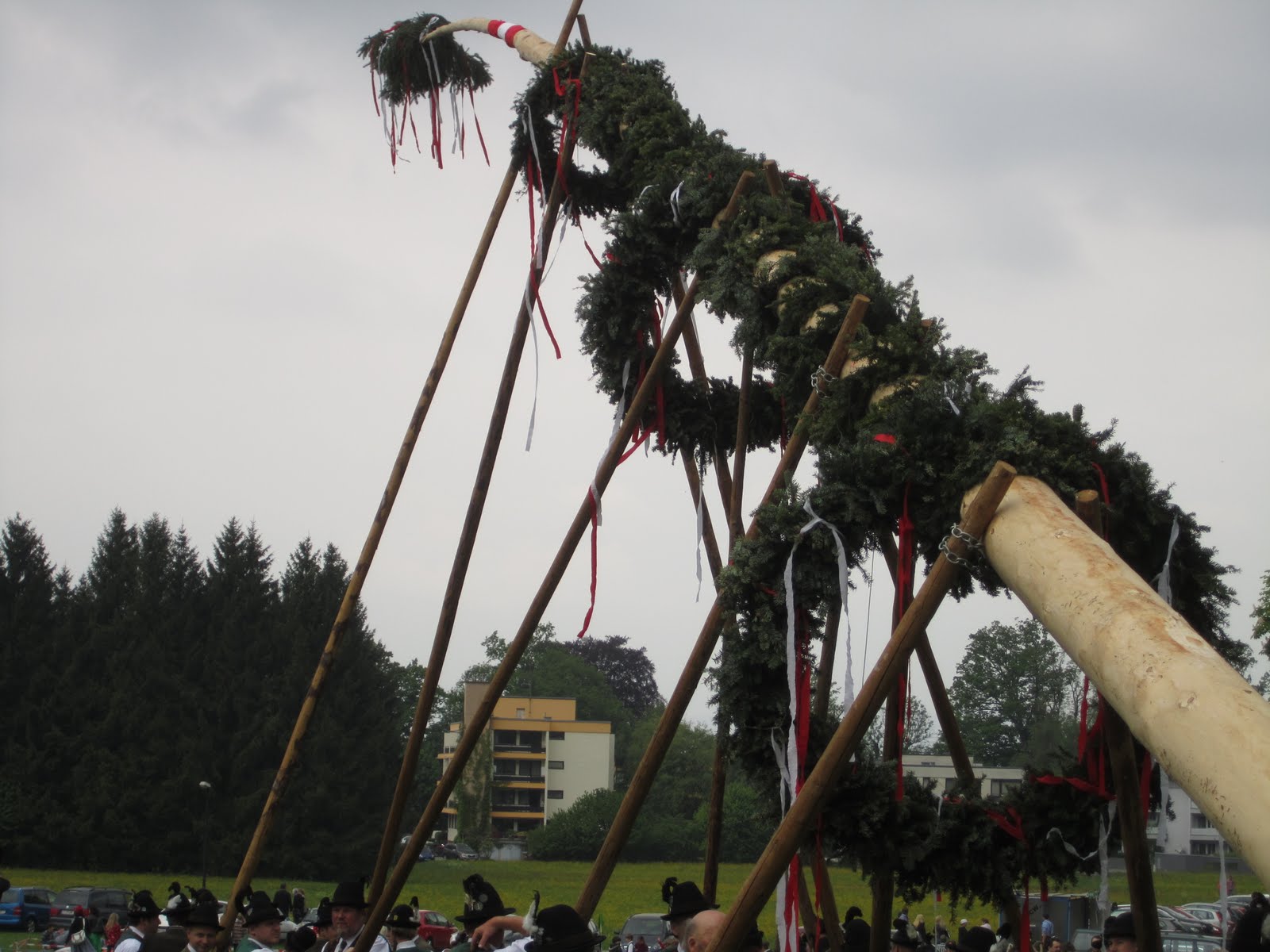
The tree, about two feet in diameter at its base, stretched over 100 feet long. Stripped of its bark, it shone a pale cream colour to its top, with was still covered with branches and green, like a diminutive Christmas tree at the tip of a long, tapering spike. Around the bare trunk were wound spirals of green decorated with streaming red and white ribbons. Circling the trunk, like twin rings of Saturn, were two wreaths of green suspended by wires. Midway between the highest of the wreaths and the tiny green top, broad stripes of red and white wrapped around the pole.
The tractor pulled the base of the tree toward a deep narrow trench at the top of the field, and slowly, very slowly, the men began inching the supports under the thick trunk backwards, so the base could be tilted into the trench. By now, I had begun to see that my anxiety not to miss anything had been unnecessary. Little did I know at the time it would take the 40 or so men over three hours to raise the tree fully upright.

Once the tractor was removed, they worked without any motorised lifts or support. Through a carefully choreographed process of supporting the trunk with large beams, they gradually shifted the gun carriage backward. As the treetop rose, inch by careful inch, they supported it with beams linked by heavy-gage chains that formed a kind of cradle in which it rested. They were directed in this by a kind of drum major, a man with a baton formed of a stick from which fluttered red and white streamers. Around the men holding the beams swarmed other men, some with long poles topped with a twin-spiked fork they jammed into the tree to reposition the chains, to add additional support and to mark the place that chains should go. Every so often the drum major would bark a command, the men would shove their weight into the beams, they would strain for a few seconds, the tree would rise, almost imperceptibly, and then they would rest.
Tied to their task, they stood in knots at various points along the ever rising tree, smoking and laughing at times. Occasionally others would bring them beers, ham-sized fists clutching the handles four or five heavy mugs in each hand. Desserts were brought out, too, which were eaten in some cases one handed, as the supports were held in place.

Around them swirled the crowd, eating, talking, drinking beer or soda or coffee, the children in their trachten standing at the edge waiting. About two hours into the process, the rain began, and the shoulders of the men’s leather jackets darkened with wet. Umbrellas bloomed in all colours over the watching crowd. Still the raising continued.

At last, though, sometime past 4 p.m., the tree stood erect and the twin wreaths of green swung around the posts levelly. Smaller logs were brought and a big, red-faced man grunted as he hammered them into the trench, firmly securing the tree. A chain saw was brought out to cut the logs even with the ground; I held my breath at each stroke, envisioning a slash across the trunk so laboriously put upright.

Now the fun for which the children had waited begun. A thick orange mat, like a donut, was put into position around the base of the trunk and children danced on it as the clamoured around the tree. A girl of about 10 put her arms around the base as others lifted her feet, trying to hoist her up.

Then a young man of about 20 stepped forward. Standing bareheaded in the light rain, he was stripped of his shirt, shoes and stockings. He had wet the front of his lederhosen, apparently to give them added traction against the smooth surface of the tree. But the rain had done its damage; the tree was too slippery and he could get no purchase.

One after another they tried. No one got more than a few feet up. One man, who approached it from the far side of where I stood, clung to it, arms and legs wrapped tight like bracelets, about 10 feet off the ground. Then he let go and dropped to the mat.

Austria it seems, is home to robust ambitions. The object here is not to dance around a pole with coloured streamers. No, here the goal is to erect a sturdy, tall tree and then climb it. And, perhaps, someone managed to reach as high as the dangling rings later in the evening. As for us, we collected our bikes and, sodden through and through, cycled back along the river and home.